Permacognitive Education

WILDE School students winter wayfinding activity, Blue Mountains
  1. About Us
    >
  2. Permacognitive Education

What Is Permacognitive Education?

WILDE School focuses on four interconnected objectives, guided by the principles of Permacognitive Education.

Education has traditionally asked:
What should children learn?

Permacognitive Education begins with a different question:
How do we intentionally design the conditions where humans naturally flourish?

The Outdoor Classroom at Wild School

Permacognitive Education is inspired by permaculture—regenerative, place-rooted design. If permaculture grows healthy soil, permacognition grows healthy minds. Both require intention, observation, and deep respect for natural systems. It is a lens of optimizing environments to suit the individual learner. And nature, we’ve learned is the optimum environment for human development.

We’ve translated this wisdom into pedagogy that integrates cognitive, emotional, physical, and relational growth—because students aren’t machines to be programmed; they’re organisms to be nurtured.

The Permacognitive Cycle

Our work is to create those conditions for each learner through a simple cycle of Observe → Design → Implement → Adapt.

1. Observe

Observe what the system needs (learners, peers, place).

Observation is the root of all learning. Invite your child to share what they’re noticing—inside themselves and in the world around them.

2. Design

Design a small, testable response.

Education is not something that happens to a child—it’s something we grow together, like a thriving garden rooted in shared care.

3. Implement

Implement it in the real world—on the land, with real users.

Learning flows in rhythms—daily, weekly, seasonal, and developmental.
Growth is not linear—it spirals and rests.

4. Adapt

Adapt based on evidence and reflection—keep what works; change what doesn’t.

Learning is not static—it evolves through feedback, experimentation, and adaptation. Mistakes are compost. Curiosity is germination.

This cycle runs through academics, leadership, and community stewardship, helping learners build durable habits of attention, creativity, and care.

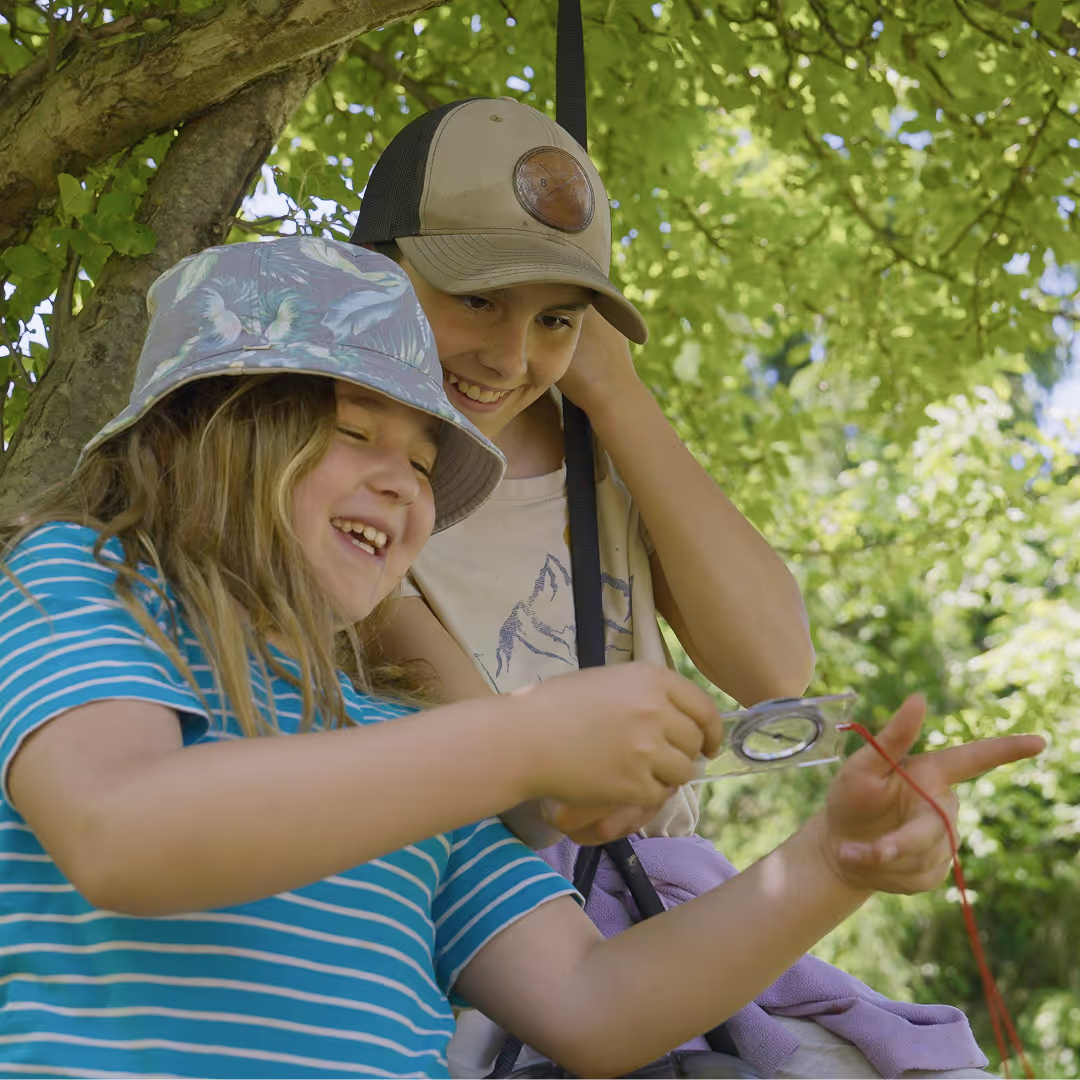
Two girls laughing with a compass, WILDE School Blue Mountains

Optimizing Conditions for Children to Thrive

Learning is more than good teaching. It emerges from a healthy ecosystem. Permacognitive Education draws insights from developmental neuroscience, psychology, ecology, systems thinking, outdoor education, and decades of educational research to intentionally design every aspect of that ecosystem: from relationships and culture to curriculum, challenge, movement, reflection, and the physical environment.

Grounded in the research of Human Ecology, we believe that just as healthy ecosystems can be intentionally designed to support life, learning ecosystems can be intentionally designed to support human flourishing.

  • WILDE School Icon

    Design Framework

    Permacognitive Education is more than a philosophy, it’s a practical design framework. Like permaculture, meaningful design begins with careful observation.

  • WILDE School Icon

    Unique Application

    Every learner, every community, and every place is unique.

  • WILDE School Icon

    Ongoing Process

    Rather than applying one-size-fits-all solutions, we continually observe, design, implement, and adapt to create the best possible conditions for learning.

From Factory Model to Forest Mindset

Most schools still run on a 19th-century industrial framework—bells, boxes, behaviour charts—top-down input to output - designed for obedience, not flourishing. But the world has changed: climate instability, screen saturation, youth mental-health crises, rapid AI disruption.

Our children don’t need more rote memorization; they need ecological intelligence.

That’s why WILDE is designed like a living system—fluid, resilient, responsive. We grow whole humans who can adapt, co-regulate, think systemically, and lead with purpose. We teach the Observe → Design → Implement → Adapt cycle so learners can navigate complexity and build solutions that care for self, community, and planet. We help them find a purposeful path, aligning passion with stewardship, so they can live sustainable, healthy, joyful lives.

A yurt in the middle of a snowy forest.

Permacognitive Design Principles for Schools

As we move beyond the outdated Industrial School model, we apply permacognitive design principles to reimagine education as an ecosystem.

Children and two adults engaging in outdoor learning under shaded canopies at picnic tables in a wooded setting.

Permacognitive Design Principles include:

  • Observe First – understand people and place before planning
  • Design with Context – root schools in local ecology and culture
  • Work with Nature – use biophilic design, natural light, gardens, and green spaces
  • Integrate, Don’t Isolate – blend subjects, age groups, and school-community partnerships
  • Value Diversity & Small-Scale Solutions – prioritize flexible, modular spaces over one-size-fits-all structures
  • Use Cycles & Feedback – build in rhythms of reflection and adaptation
  • Leadership as Stewardship – redefine leadership as care for systems
  • Regeneration, Not Extraction – leave people and places healthier through education

The 7 Principles of Permacognitive Education (Alive in Daily Practice)

1. Cognitive Ecology

Thinking emerges in relationship with place, tools, and people.

Forests as classrooms; classrooms as ecosystems.

2. Curriculum as Living Design

We don’t “deliver” curriculum; we grow it.

Snowfall becomes a fractal math inquiry; a question becomes a unit.

3. Regenerative Place-Based Learning

Students don’t just learn in nature—they restore it.

Pollinator gardens, watershed mapping, soil checks.

4. Embodied Resilience

Emotions are data, not detours.

Breath work, grounding, and body awareness alongside reading and science.

5. Systems Thinking

Students see patterns and feedback loops.

A food unit touches climate, equity, culture, economics.

6. Time Awareness

Nature doesn’t rush; we honor cycles and timing.

Seasonal rhythms over rigid deadlines.

7. Inner Sustainability

Success isn’t a grade; it’s a compass.

Each learner builds a reflective plan aligned to strengths and values.

Grounded in Science, Guided by Nature

  • Neuroscience shows learning is multi sensory, embodied, and context-dependent.
  • Ecopsychology finds nature-based education improves attention, memory, creativity, and emotional regulation.
  • Polyvagal-informed practice reminds us nervous-system safety is foundational for engagement and growth.
  • Permaculture design gives us a blueprint for systems that regenerate rather than deplete.

When students learn in ways that are calm, connected, and outdoors, attention improves, stress lowers, and learning sticks. Translation? Smarter, healthier, happier kids.

Research Snapshot (for the curious)

  • Nature & learning: Integrative review finds nature experiences boost academic learning and engagement via attention restoration and stress reduction (Kuo, Barnes, & Jordan, 2019).
  • School green space & cognition: Longitudinal study links greener schools with improved working memory and reduced inattentiveness (Dadvand et al., 2015).
  • Mental health & resilience: Systematic review shows immersive nature experiences support mental, physical, and social health for children and youth (Mygind et al., 2019).
  • Leadership & agency: Meta-analysis of outdoor/adventure education reports meaningful gains in self-concept, leadership, and interpersonal skills, often growing over time (Hattie, Marsh, Neill, & Richards, 1997).
Explore the Research

A New Kind of Leadership

At WILDE, leadership isn’t a position—it’s a way of being. Our Permacognitive Leadership approach threads emotional intelligence, somatic awareness, and ecological fluency through real-world projects. Students hike, interview elders, sleep under stars, and co-design solutions with partners. The world doesn’t need more empire-managers; it needs bridge-builders, ecosystem stewards, and visionaries.

We’re Not Preparing Kids for the World. We’re Equipping Them to Regenerate It.

Our students don’t just memorize sustainability; they practice it—on the land, in their bodies, and in their communities. They lead stewardship projects, track nervous-system states, mentor younger students, and launch campaigns that matter.

They are resilient, not rigid.

Curious, not compliant.

Prepared for life, not just tests.

Four smiling boys standing outdoors with arms around each other, wearing matching black t-shirts with a crossed arrows logo and two wearing black caps.

What Happens When You Teach This Way?

  • Students once disengaged show up eager, curious, and energized—ready to build, explore, and connect in a place that feels like it was made for them.
  • Learners who struggled with self-regulation now teach breath work to peers.
  • Students with anxiety find calm in land-based learning—and voice in public showcases.

Most importantly, they’re becoming themselves—confident, grounded, purposeful.

More from the WILDE Blog

Rewilding Education: How We’re Doing It—and Why It’s Working

Rewilding Education: How We’re Doing It—and Why It’s Working

How WILDE School Blue Mountains is rewilding education through outdoor, nature-based learning — and the remarkable results it is producing.

Published:

March 18, 2026

Schools for Living Systems: The Impact of Permacognitive Education

Jeff Barrett asks what school would look like if it followed how young brains grow. He introduces Permacognitive Education, or Perm. Ed., at WILDE School. Students learn through real work, then teachers adapt from what they see.

Wilde School is committed to providing a holistic and experiential learning environment that fosters curiosity, resilience, and a love for learning. Our educational approach integrates academic rigor with outdoor exploration, emotional intelligence, and community engagement to nurture well-rounded individuals prepared for lifelong success.

Our curriculum at Wilde School emphasizes hands-on, experiential learning, outdoor exploration, and the development of essential life skills alongside academic subjects. We focus on fostering a growth mindset, building healthy relationships, and instilling leadership qualities in our students to prepare them for the challenges and opportunities of the 21st century.

Yes, Wilde School adheres to the Ontario curriculum, but we enrich this framework with our distinctive approach which we call ‘the living curriculum’ and includes experiential learning, outdoor exploration, and character development. Our curriculum is not only about meeting the standard educational requirements but also about inspiring a deeper love for learning and fostering essential life skills. What's particularly fascinating is that our students consistently surpass the baseline expectations for their grade level. This achievement is a testament to the effectiveness of our holistic educational model, which nurtures curiosity, resilience, and a passion for continuous growth in each student.

We regularly assess and monitor student progress through ongoing formative and summative assessments, teacher observations, and student portfolios. We provide comprehensive report cards twice a year to communicate student achievement and growth in alignment with the Ontario curriculum. In addition, we create a Strategic Student Plan with our students and parents that sets out their goals and objectives for the year. We revisit this plan halfway through the year and re-evaluate its trajectory.

At Wilde School, we prioritize inclusivity and personalized learning. Our educators are skilled in differentiating instruction to meet each student's unique needs, offering additional support, accommodations, or enrichment as required to ensure every student thrives. The small class sizes at Wilde School further enhance this tailored approach, allowing for individualized attention and fostering a supportive learning environment where every student can succeed.

Want to experience it for real?

Join Us!

Come walk the trail with us.